Introduction
In order to understand how Tesla Coil works, we first need to understand the LC Oscillator circuit.
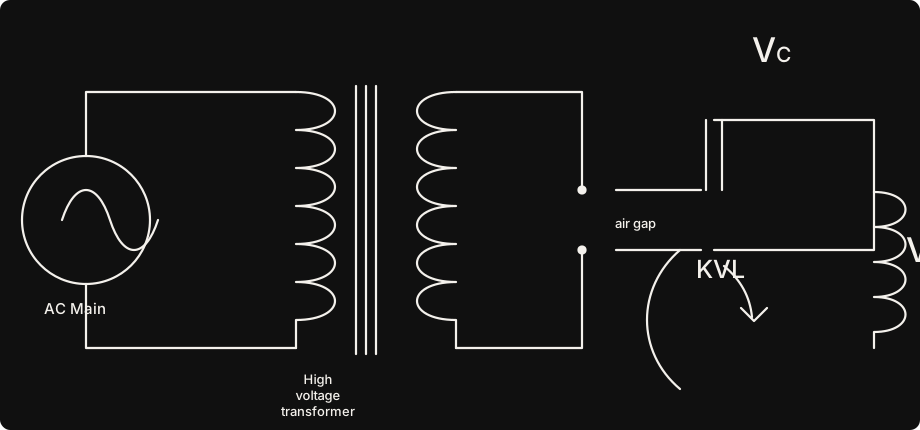
For the lazy kind like me just want to know the “how-it-works”:
- Initial condition: there’s no charge in the capacitor.
- The air gap remains open, no current flow.
- With present of AC source, the capacitor will be charged until the voltage is high enough to breakdown the air gap and form a close circuit.
- When the air gap is breakdown, the capacitor and inductor forms a LC oscillator circuit.
- The electrical signal is oscillating at a very high frequency .
- The secondary coil of the transformer has large inductance .
- Hence, the impedance of secondary coil of the transformer .
- It acts like an open circuit.
- The circuit become a circuit when the air gap break down.
Theoretical approach of a series LC circuit
1. KVL and Circuit Elements
In the following text, lower case symbol annotates signals in time domain, while uppercase means signals represented in domain.
Referring the series LC circuit of the diagram, Kirchhoff’s Voltage Law (KVL) says that the sum of the voltage drops across the inductor () and the capacitor () must equal the source voltage.
Assuming a voltage source , we have:
For an ideal inductor, the voltage drop across it is proportional to the rate of change of the current flowing through it:
For an ideal capacitor, the current flowing through it is proportional to the rate of change of the voltage across it, and from it we can express the voltage across the capacitor as:
2. Formulating the Differential Equation
Substituting the expressions for and into the KVL equation:
3. Solving the Homogeneous Equation
The homogeneous equation has a meaning in this circuit: without the external voltage source applied, i.e., . It’s the state when the air gap is break down, and the transformer is open circuit, and the current across the capacitor and inductor can be formulated as:
The Laplace Transform is a nice tool to turn a differential equation into simple algebraic problem, and I’m going to solve for the current signal using it, assuming there’s no charge across the capacitor, all the energy is stored in the inductor as in the form of magnetic field, hence there’s a initial current induced when the source is removed:
Now let , then
The voltage across inductor is
4. General Solution with Voltage Source
If there is a voltage source , the Laplace transform become
The current in capacitor , hence .
is like the voltage due to initial charge in the capacitor at . Therefore
Before simplifying the equation, look, the denominator , isn’t it the sum of the impedance of the inductance and capacitor? A.k.a the total impedance of the circuit.
Now multiple numerator and denominator by and again as defined :
Interestingly, if you solve this by normal differential equation, the first two terms are just the solution of the homogeneous equation (natural response), and the last term is the particular solution (forced response), the all together form the general solution
The particular solution depends on the form of . For example, if the voltage source is a constant (DC voltage), the steady-state current would be zero (since a DC source in series with an ideal inductor leads to zero steady-state current). The transient response would then be given by the homogeneous solution with constants determined by the initial charge on the capacitor and initial current through the inductor.
If the voltage source is sinusoidal, , where is the source angular frequency, then , we can solve
You will notice after scanning through the Laplace transform table, there ain’t no one reverse transform on it for this kind of expression. Luckily, our high school partial fraction is here for the rescue.
So we’re going to solve for the coefficient , , and :
Comparing the like terms,
Put it back to the equation
Therefore
We can do this for other input such as impulse, unit step and so on, to get their response, but since the focus here is on Tesla coil, the transformer is sourced from AC power, we shall focus on the sinusoidal input.
5. Make Sense of the Formula
5.1 No Input Source
Imagine there’s no , it would be easier the whole formula left just only the first two terms
This is essentially the homogeneous solution of the previous section. It has a physical world implication. If the capacitor is initially charged to , say , and it’s enough to break through the air gap at . For convenient of calculation and illustration, let , , as defined earlier , .
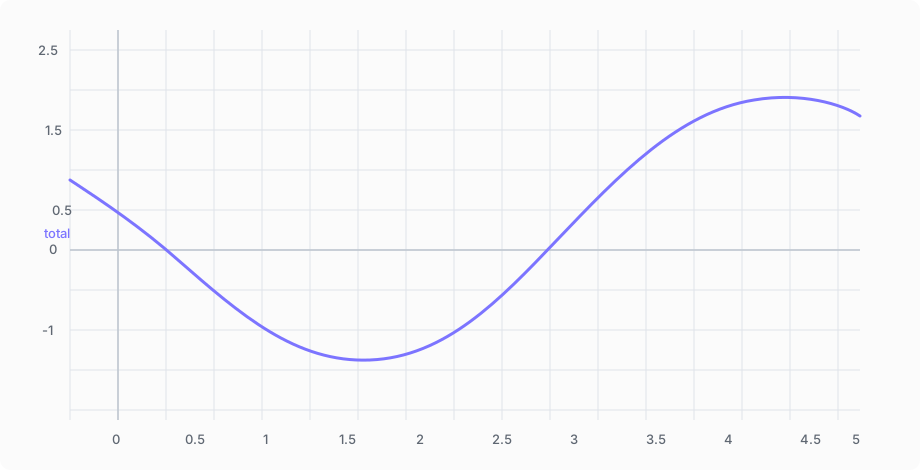
In an ideal LC circuit, the sinusoidal signal will goes on forever, however, in reality there’s always resistance and flux leakage losses in the winding, so the signal will decay overtime.
Notice that the unit of is essentially ampere (), which is the same as the other side of the equation (), and the denominator is the impedance of the inductor.
5.2 No Initial Condition
If there’s no charges in capacitor and no magnetic energy is stored in inductor, i.e. and , then the formula only left just the third term
The unit of this terms seems correct as the unit of the coefficient is still . I actually don’t know what this term is used for, it looks like the signal from the source (low frequency) is adding on top of a signal that’s oscillating at the resonance frequency of the LC circuit. If anyone would enlighten me, please write me an email. Anyway, reader can plug in appropriate value into Geogebra and should observe the lower frequency is seems like “wrapping” the high frequency signal, like the old school amplitude modulation.
6. Summary
I think more of this post is like a mathematical tool revision for me. The important point is, since we’re using a high voltage transformer, will be increase at the secondary winding to break down the air gap, and all we need is the homogeneous equation - then the air gap is break down, the LC circuit will oscillating at the resonance frequency. Then we can decide the value of inductor and capacitor of the Tesla coil.